Pre-Hispanic Roots
Before Catholicism arrived, death already held a central place in Mexica cosmology: Mictlantecuhtli and Mictecacíhuatl, lord and lady of Mictlán, governed the realm of the dead as a necessary part of the cosmic cycle — not as punishment, but simply as another stage. Many historians point to this pairing as a cultural antecedent, though not a direct, proven origin of today's Santa Muerte.
The Skeleton Image Arrives From Europe
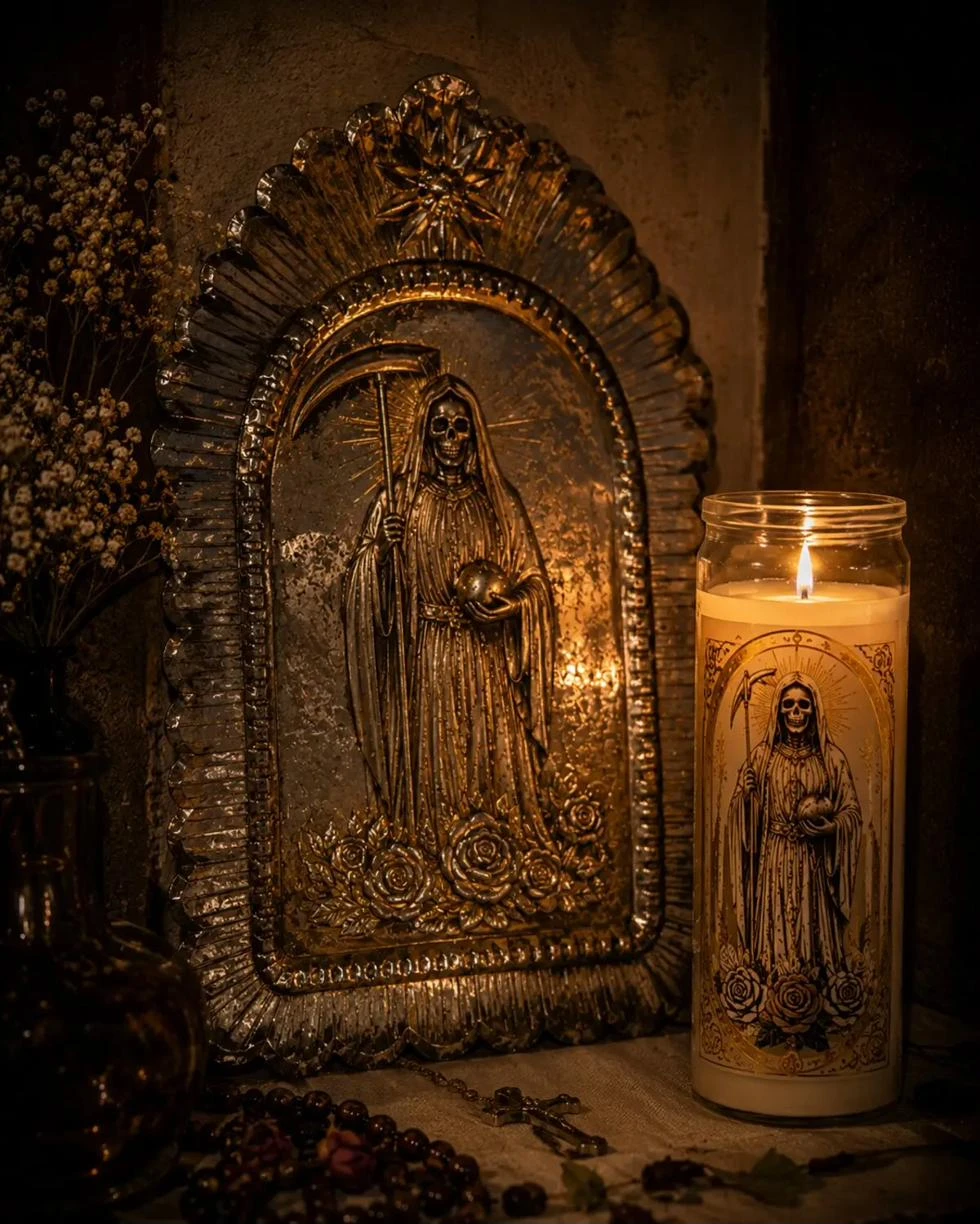
The depiction of death as a skeleton with a scythe isn't Mexican in origin — it arrived with the Spanish colonizers. In Europe, that image became popular between the 15th and 18th centuries, during the epidemics and famines that gave rise to the so-called Danse Macabre. Over time, the figure took on its own attributes — the scythe, the robe, the globe in her hands — until she became an entity with a recognizable personality of her own.
A Little-Known New Spain Antecedent
Some anthropologists, such as Katia Perdigón, trace a Mexican cult of death back to the 17th century, in the veneration of a figure known as San Pascualito Rey. Alongside this, another hypothesis holds that the devotion was passed down orally across generations within Indigenous communities, precisely to avoid reprisals from the conservative religious authorities of the time.
From Hidden Cult to Visible Devotion
The first documented public manifestation of the cult took place in 1965, in Hidalgo. Decades later, the appearance of visible altars in public — the best known in the Tepito neighborhood of Mexico City, in 2001 — marked the shift from a mostly private devotion to an open presence in streets, markets, and homes.
Who Venerates Her
In its earliest public manifestations, the cult was associated above all with people whose work carried constant risk to life. Over the decades, the devotion has spread notably among other groups historically stigmatized by conservative sectors — sex workers, the LGBT+ community, and those working in the informal economy, among many other devotees who fit none of these descriptions.
A Tense Relationship With the Church
Various Christian churches have condemned the cult as incompatible with their doctrines — venerating death as an end in itself runs counter, in particular, to the Catholic dogma of resurrection. Despite this, many devotees see no contradiction between attending Mass and keeping an altar at home — for them, the devotion lives in a space of its own.
Celebration Dates
The dates most associated with her celebration are August 25th and November 2nd — the latter coinciding with Día de Muertos, within the broader calendar of Mexican traditions connected to death.
Did you know there's a distinct devotion with a similar name? San La Muerte is a male, protective figure specific to northeastern Argentina — with his own history, separate from this Mexican tradition.