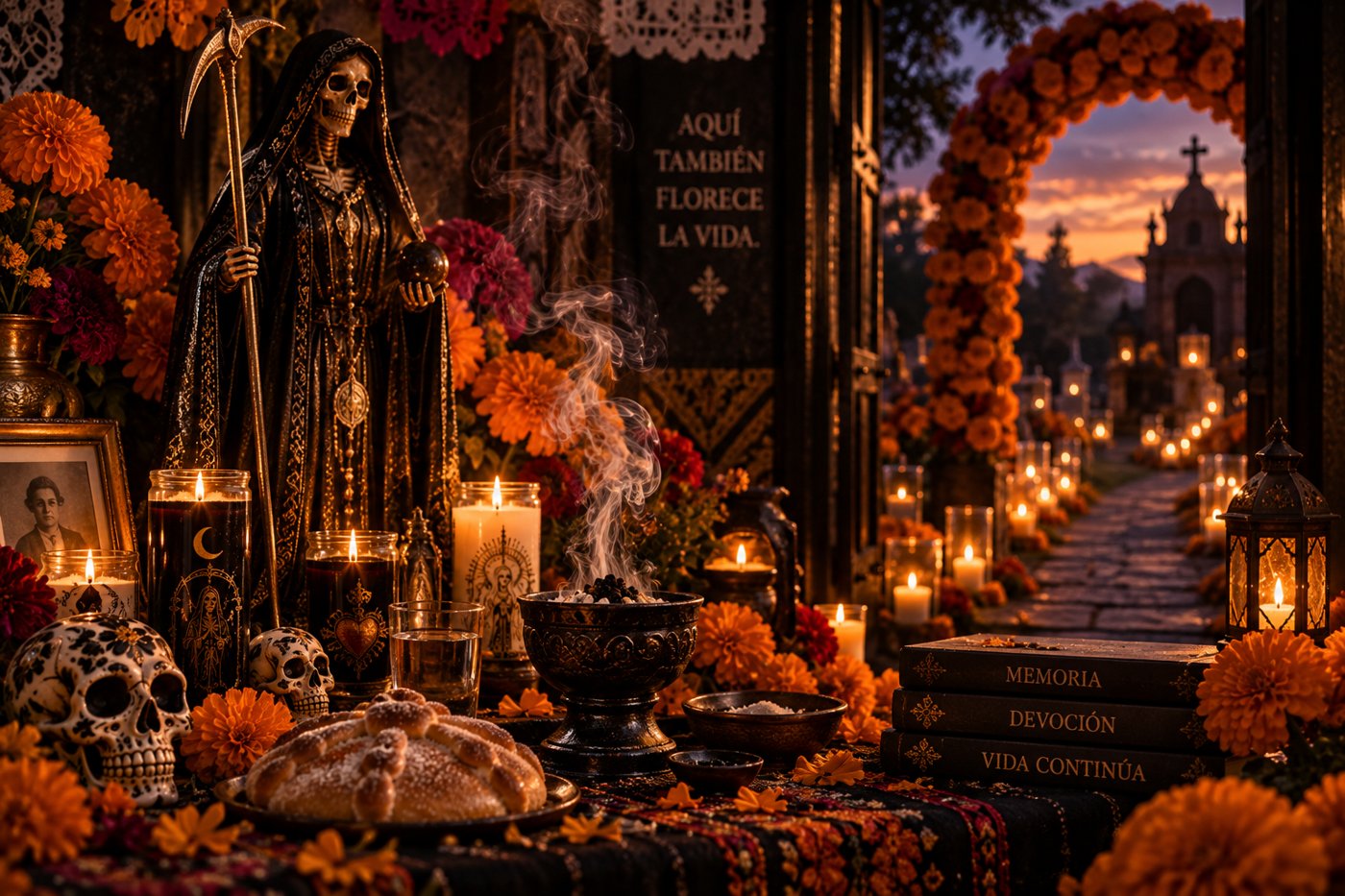
Two Distinct Traditions
Day of the Dead (Día de Muertos) is a documented Mexican tradition with a fixed date (November 1st and 2nd), recognized by UNESCO as an Intangible Cultural Heritage of Humanity. Its central purpose is honoring and remembering specific family members and loved ones who have died — it isn't centered on any particular devotional figure, but on the memory of specific people.
Santa Muerte devotion is a separate popular practice, sustained year-round, directed at a personified figure to whom petitions are made — protection, health, work, love — and thanked when those petitions are granted. In its most common form, it isn't centered on honoring specific deceased people.
Historically, the two traditions have distinct origins and development (see our guide on Santa Muerte's history and origin). They are not the same devotion, even though they overlap in some symbols and on the calendar.
Why Are They Confused So Often?
Several practical reasons explain the confusion. Both traditions use death-related imagery — skulls, skeletons, veladoras. Both occur on nearby calendar dates. And both are often presented together, without distinction, in media coverage, social media, and commercial products aimed at audiences who don't know the difference between the two. That constant visual blending ends up suggesting they're the same thing, when they aren't.
The Real Point of Connection: November 2nd
Here's a genuine overlap, not an invented one: November 2nd — All Souls' Day, within the Day of the Dead calendar — is also one of the two dates most associated with Santa Muerte's own celebration, alongside August 25th. For many devotees, that specific date does function as a real meeting point between the two practices. That doesn't turn the two traditions into one — it remains a calendar coincidence, not a fusion of origin or purpose.
Remembering the Dead vs. Petitioning Santa Muerte
The underlying difference is this: Day of the Dead is about remembering and honoring specific people who have died — with their name, their photo, their favorite food. Santa Muerte devotion, in its most common form, is about asking a figure for help with the problems of the living. A devotee might practice only one of the two traditions, both separately, or both interwoven — but that depends entirely on family and region, not on any fixed rule of the devotion.
Altar Practices That Sometimes Overlap
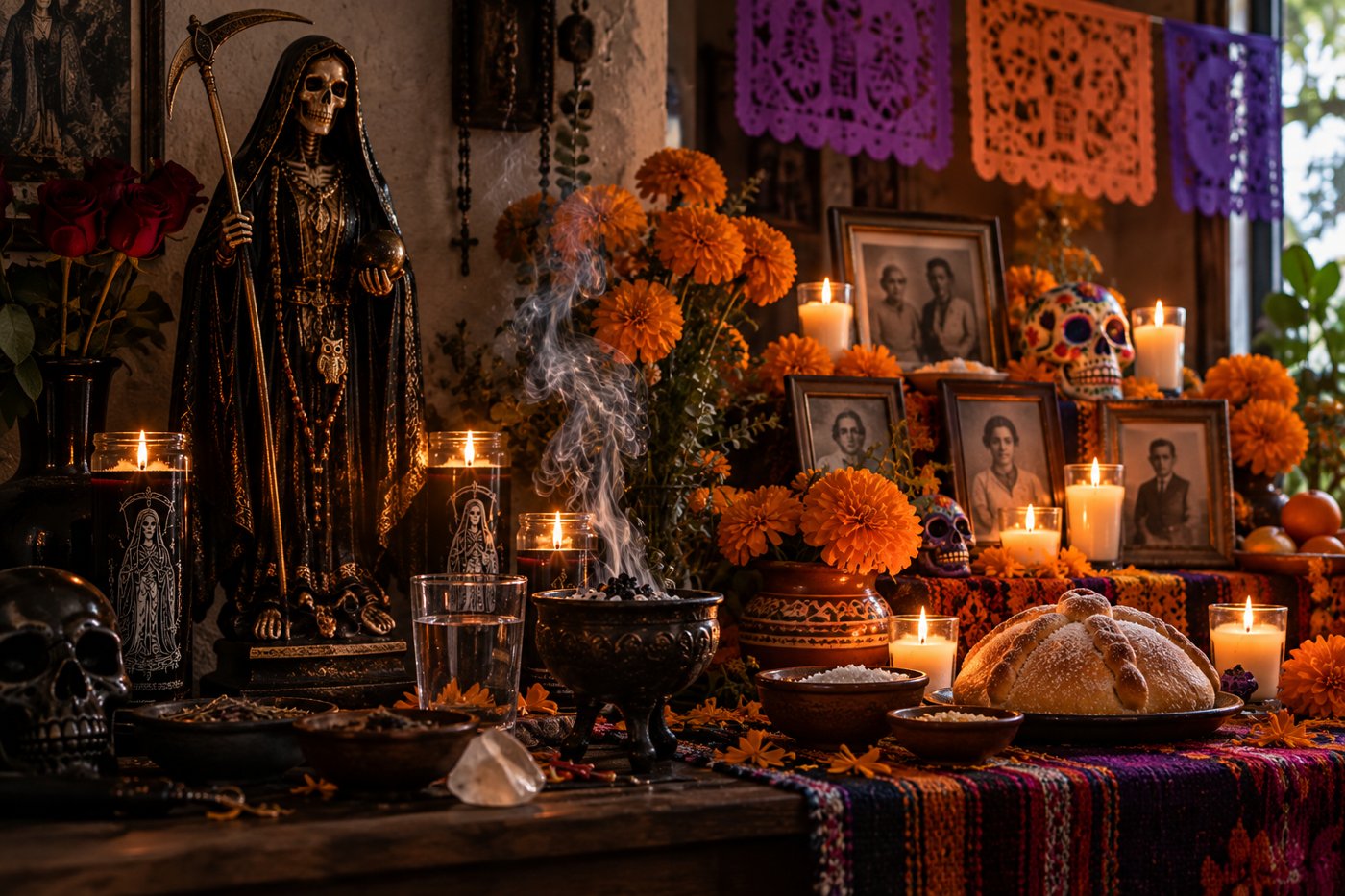
During this time of year, some devotees combine elements of both traditions on their altar. None of these combinations are required — they're described here as observed real practice, not as rules.
Water. In Day of the Dead, a glass of water is offered to quench the thirst of souls returning from their journey. In Santa Muerte devotion, water is already one of the three basic elements of any altar, year-round (see our altar-building guide). During this season, some devotees hold both meanings at once, without one replacing the other.
Veladoras. Veladoras are already central to the devotion year-round, chosen by color and petition (see the complete color guide). In Day of the Dead, candles also serve to light the way for returning souls. Some devotees, during this period, light an additional veladora specifically for that second purpose.
Copal. Copal is a pre-Hispanic incense, present both in Day of the Dead offerings and in everyday Santa Muerte devotional practice (cleansing the altar, accompanying a petition). Its use in both traditions isn't coincidence — they share a cultural root much older than either tradition.
Cempasúchil (marigold). This is the flower most associated with Day of the Dead — its color and scent are said to guide souls back home. It isn't, however, a traditionally documented flower on the Santa Muerte altar, where white or red roses are more commonly cited. During this season, some devotees add cempasúchil to their altar as a seasonal gesture — but it shouldn't be presented as a required or traditional element of Santa Muerte devotion itself.
Photographs and personal mementos. Placing photographs of deceased family members is a central, essential element of any Day of the Dead ofrenda. It isn't, by contrast, a usual part of a Santa Muerte altar, which centers on the image of the Niña Blanca herself, not photographs of the deceased. Devotees who observe both traditions sometimes set up a separate space for family photographs, near the altar but distinct from it.
Offerings and food. Pan de muerto, sugar skulls, and the deceased's favorite food are offerings specific to Day of the Dead. The offerings already documented in Santa Muerte devotion — fruit, bread, coins, flowers — sometimes overlap in form (bread, for instance), but not in purpose: one symbolically feeds a specific returning soul; the other sustains reciprocity with Santa Muerte herself.
Copal and the use of veladoras to mark a path share pre-Hispanic roots — they didn't arrive at either tradition separately, but are part of a much older Mexican cultural foundation than both.
What a Santa Muerte Devotee Might Do During This Period
This varies widely by family and region — there's no single correct path. Among what's observed most often:
- Keeping the altar exactly as the rest of the year, with no changes at all.
- Adding a separate space with photographs of deceased family members, distinct from the Santa Muerte altar.
- Incorporating cempasúchil or pan de muerto as an additional seasonal offering, without replacing the usual ones.
- Using November 2nd for a special petition or thanks, since it coincides with one of the devotion's own two dates.
- Visiting a public or community altar, where both traditions sometimes visually coexist without merging into one.
What Shouldn't Be Presented as a Universal Rule
- Not every Santa Muerte devotee celebrates or takes part in Day of the Dead.
- There is no "official veladora" for Day of the Dead within Santa Muerte devotion.
- Cempasúchil isn't a traditionally documented element of the Santa Muerte altar — its use during this season is a seasonal practice some adopt, not a requirement of the devotion.
- Santa Muerte shouldn't be presented as "the patron of Day of the Dead" — there's no historical evidence she's a central figure of that tradition.
- The November 2nd overlap shouldn't be presented as if the two traditions were, underneath, one and the same.
Related: How to Build an Altar → · Color Guide → · Prayers → · History and Origin → · Gratitude Prayer →